
The 50/30/20 Budget Rule: A Simple Way to Split Your Pay
 Start free trial
Most budgeting advice starts with a spreadsheet full of categories. The 50/30/20 rule starts with just three numbers. It's one of the simplest ways to plan a monthly budget, and it's a good fit if you've never had a budget before, or if you've tried a detailed one and given up.
This article explains what the rule is, works through an example with round numbers, covers the tricky "is this a need or a want?" cases, and looks at when the split should change and where the rule falls short.
What the 50/30/20 rule is
The rule divides your monthly take-home pay (what actually lands in your account after tax) into three parts:
- 50% for needs: the things you have to pay to live and work.
- 30% for wants: the things that make life enjoyable but that you could cut if you had to.
- 20% for savings: money set aside for the future, including paying down debt faster than the minimum.
It was popularised by Elizabeth Warren and her daughter Amelia Warren Tyagi in their 2005 book All Your Worth: The Ultimate Lifetime Money Plan. The idea isn't that these exact percentages are perfect for everyone. It's that three broad buckets are much easier to stick to than thirty narrow ones, and the split gives you a sensible place to start.
A worked example
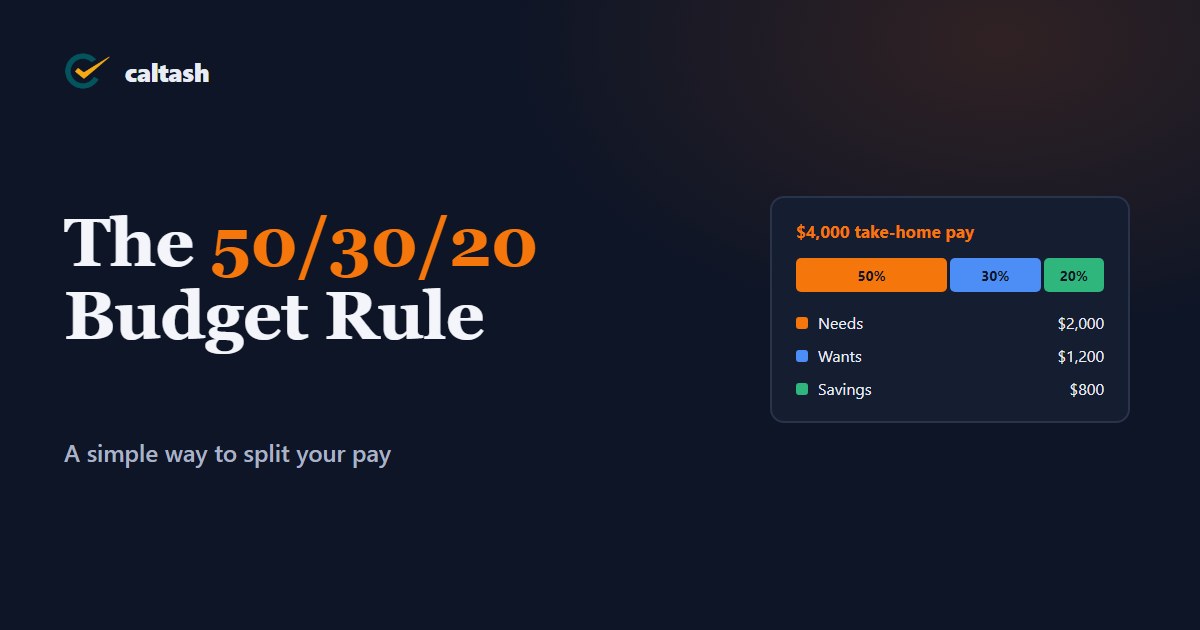
Say your take-home pay is $4,000 a month. The rule splits it like this:
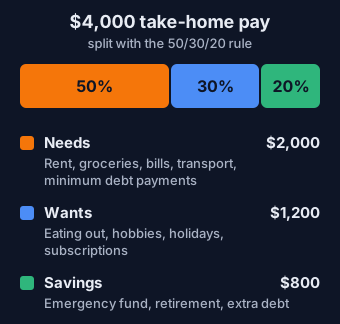
Here's how those three amounts might break down into real spending:
| Bucket | Item | Amount |
|---|---|---|
| Needs (50%) | Rent | $1,300 |
| Groceries | $350 | |
| Utilities and phone | $150 | |
| Transport | $150 | |
| Insurance | $50 | |
| Needs total | $2,000 | |
| Wants (30%) | Eating out and takeaway | $300 |
| Holiday fund | $300 | |
| Hobbies | $200 | |
| Clothes | $150 | |
| Gifts | $100 | |
| Streaming and subscriptions | $50 | |
| Everything else | $100 | |
| Wants total | $1,200 | |
| Savings (20%) | Emergency fund | $400 |
| Retirement | $300 | |
| Extra credit card payment | $100 | |
| Savings total | $800 |
The numbers work the same way in any currency. If your income is different, multiply it by 0.5, 0.3 and 0.2 and you have your three targets.
What counts as a need, a want, or savings
Most items sort themselves easily. Rent is a need; a streaming service is a want. The useful question for the unclear ones is: if money got really tight, would I still have to pay this?
Needs usually include housing, groceries, utilities, a basic phone plan, transport to work, insurance, childcare you need in order to work, and the minimum payments on any debts. Minimum payments go here because they aren't optional: missing them costs you fees and damages your credit.
Wants usually include eating out, takeaway, entertainment, hobbies, holidays, gym memberships, new clothes beyond the basics, and upgrades to a need (a bigger flat than you need, the premium phone plan, a nicer car than the job requires).
Savings covers anything that improves your future position: an emergency fund, retirement contributions, saving for a home deposit, and any debt payment above the minimum. Paying off a credit card faster improves your finances just like saving does, and usually by more, because card interest is higher than what savings earn. That's why it belongs in the same bucket.
A few edge cases worth deciding once and then sticking to:
- Groceries vs. eating out. Food at home is a need; meals out and takeaway are wants, even though both are "food."
- A car. If you need a car to get to work, the payment is a need. If it's a much more expensive car than you need, part of it is really a want. You don't have to split the payment in your budget, but it's worth noticing if it's crowding out everything else.
- Retirement taken from your pay before it arrives. Some employers deduct pension or retirement contributions before your take-home pay. You can either leave those out of the rule entirely, or add them back to your income and count them as savings. Either works, as long as you do it the same way every month.
- Yearly bills. Car registration, annual insurance or a yearly subscription can wreck one month's budget. Divide the yearly cost by 12 and set that amount aside each month in the right bucket.
When to change the split
The 50/30/20 split is a starting point, not a law. Some common situations call for different numbers.
You live somewhere expensive. In a high-cost city, rent alone can take half of your take-home pay, pushing needs to 60% or more. If that's you, take the difference out of wants first, and try to keep at least some savings going every month, even if it's less than 20%. A small, steady amount builds the habit and the cushion.
Your income is irregular. If you're freelance, work on commission, or have seasonal work, base the budget on a low month rather than an average one. In good months, the extra goes to savings or to a buffer you can draw on in lean months. That keeps your needs covered without guessing.
You're paying off expensive debt. If you're carrying high-interest debt like a credit card balance, it can make sense to shrink wants for a while and move that money to extra debt payments. Something like 50/20/30, with the larger 30% going to savings and debt, gets you out faster. Once the debt is gone, move back toward the original split.
Your income is high or your costs are low. If your needs only take 35% of your pay, you don't have to spend the rest on wants. Moving more into savings speeds up every long-term goal.
Where the rule falls short
The 50/30/20 rule is popular because it's simple, and the simplicity has some limits:
- It doesn't tell you what to save for first. "20% to savings" doesn't say whether that should go to an emergency fund, retirement, or a deposit on a home. Those priorities depend on your situation.
- Percentages ignore real amounts. On a low income, needs can easily exceed 50% no matter how careful you are, and 20% savings may not be realistic at first. On a high income, 30% for wants can be a lot more than you'd actually want to spend.
- The lines between categories blur. Is a gym membership a want, or part of looking after your health? Is a work laptop a need? The rule only works if you make a call on these and stay consistent.
- It's a plan, not a record. Setting the three targets is the easy part. The rule only helps if you check, at least monthly, where the money actually went.
None of this makes the rule less useful. It just means it's a first draft of your budget, not the final version.
Try it with your own numbers
The quickest way to see what the rule means for you is to put your real income in. Our free budget calculator has a "Start from 50/30/20" button that fills in your three targets from your income, and you can then break each one down into your own categories. No sign-up needed, and nothing you type leaves your browser.
If you want to track it month by month, Caltash lets you set a budget for each category and shows what you've spent and what's left. Start a free 14-day trial, no card required.
This article is general information, not financial advice. Talk to a qualified adviser for guidance specific to your situation.
Start free trial