
How to Track Household Expenses as a Family
 Start free trial
When two or more people share a household, money gets spent from different cards, by different people, on different days. Nobody is doing anything wrong, but at the end of the month it's hard to say where it all went. Tracking your household expenses together fixes that, and it doesn't need to take long.
This article covers why tracking is worth the effort, how to choose categories, which habits to build each week and each month, how to share the job between partners, how to plan for the costs that only come up once or twice a year, and the mistakes that make families give up.
Why tracking is worth it
- You find out where the money actually goes. It's easy to underestimate at least one category, usually food, subscriptions or small everyday purchases.
- It turns arguments into decisions. "We spend too much" is hard to discuss. "We spent $480 on takeaway last month" is something you can agree to change.
- Big bills stop being surprises. Once you can see what's coming, a car registration or a school trip is something you planned for, not a shock.
- It makes a budget possible. You can't plan next month well without knowing what this month cost.
Choose a short list of categories
The most common reason a family stops tracking is that the system is too detailed. Start with about ten categories. You can always split one later if you need more detail.
A starter list for most households:
- Housing: rent or mortgage, rates, home insurance
- Utilities: electricity, gas, water, internet, phones
- Groceries: food and household supplies from the supermarket
- Transport: fuel, public transport, parking, car insurance and servicing
- Children: childcare, school costs, activities, clothes
- Health: doctor, dentist, pharmacy, health insurance
- Eating out: restaurants, cafes, takeaway
- Fun and holidays: entertainment, hobbies, trips, gifts
- Subscriptions: streaming, apps, memberships
- Savings and debt: money set aside, and any extra debt payments
Two rules help keep it tidy. First, put every purchase in exactly one category, even if it's a close call; consistency matters more than perfection. Second, decide the awkward ones together once (is a school uniform "Children" or "Clothes"?) and write the answer down.
Weekly or monthly?
Both, but they do different jobs.
Each week, a quick check-in. Ten or fifteen minutes on the same evening each week. Record anything that isn't already in your tracker, put each item in a category, and glance at how the month is going. Weekly is often enough that nobody has to remember what a payment was for.
Each month, a proper review. Once a month, sit down together for half an hour and look at the whole picture (more on this below).
If weekly feels like too much, start with monthly only. A habit you actually keep beats a better one you drop after three weeks.
Sharing the job between partners
There's no single right way to split the work, but it helps to agree on one. Some arrangements that work for many couples:
- One keeps the records, both review. One person enters and categorises everything; the other joins the monthly review. This works well when one partner enjoys it more, as long as the review really is shared.
- Split by account or card. Each person records what they spent on their own card, and the joint account is done together or by whoever pays the bills.
- Take turns. Swap who does the weekly check-in each month, so you both stay familiar with the numbers.
Whichever you choose, agree on the categories, agree on a regular time, and agree on what happens when something is unclear (a quick message, a note in the tracker, or a question saved for the review). And whatever the arrangement, the review is a shared look at the numbers, not a chance to criticise each other's spending.
Plan for irregular and yearly costs
Some costs only come up once or twice a year: car registration, annual insurance, school fees, birthdays and holidays, a boiler service. They're easy to forget when you look at a normal month, and then one month gets wrecked.
The fix is to list them, add them up, and set aside a twelfth of the total each month, often in a separate savings account. Here's an example with round numbers:
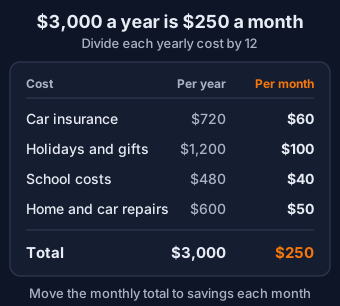
When a yearly bill arrives, pay it from the money you've set aside. It's still a real cost, so record it in its normal category; the difference is that it no longer comes out of that month's everyday spending.
For costs that vary from month to month (energy bills in winter, for example), use an average of the last year if you have one, and adjust as you go.
Review at month end
The monthly review is where tracking turns into better decisions. A simple agenda:
- Make sure the month is complete. Every account and card is up to date, and every item has a category.
- Compare with your plan. For each category, what did you plan to spend and what did you actually spend?
- Talk about the biggest differences. Not every small one; pick the two or three that matter.
- Check the yearly-costs fund. Did this month's set-aside go in? Is anything big coming up soon?
- Agree on one change for next month. One is enough. Write it down.
Common mistakes
- Too many categories. Twenty categories means twenty decisions per receipt. Start small.
- Tracking only one person's spending. If only one partner's purchases go in, the totals will always look too low.
- Leaving out cash and small purchases. Coffee, parking and the school bake sale add up. Record them, or set a weekly cash amount and record that.
- Forgetting the yearly costs. A month that looks fine on paper can fall apart when the car insurance renews.
- Giving up after a bad month. The point of tracking is to see the bad months. Look at what happened, adjust, and carry on.
- Using the numbers to blame. If the review feels like an argument, people stop recording things. Keep it about the plan, not the person.
Tools that help
If you don't have a budget yet, our free budget calculator lets you enter your monthly income and plan an amount for each category, with a "Start from 50/30/20" button if you'd like a starting split. No sign-up needed, and nothing you type leaves your browser. The 50/30/20 budget rule article explains that split and when to change it.
To track the month itself, Caltash's personal mode keeps your accounts and transactions in one place, lets you set up your own categories, and lets you set a monthly budget for each category that shows what you've spent and what's left. If you build a budget in the calculator first, Caltash offers to apply it to a new personal workspace when you sign up.
On sharing: one person adds and edits entries in a personal workspace. On the Personal Plus plan you can also invite up to two read-only viewers, so a partner can see the same numbers without changing them. The free plan is for one user.
Want to try it? Start a free 14-day trial, no card required.
This article is general information, not financial advice. Talk to a qualified adviser for guidance specific to your situation.
Start free trial